


Blogs
5 GHz vs 6 GHz Wi-Fi: Coverage, Power Classes, and Design Implications
February 26, 2026
There has been a lot of discussion recently around 6 GHz Wi-Fi. Some of it focuses on throughput. Some of it focuses on coverage. And some of it assumes that because 6 GHz is newer, it must behave fundamentally differently.
In the webinar that prompted this write-up, the goal wasn’t to declare one band “better” than another. It was to walk through the mechanics of 5 GHz and 6 GHz carefully, from first principles, and test a few assumptions along the way.
One of the biggest practical takeaways was not about modulation or channel width, but Low Power Indoor (LPI) vs Standard Power with AFC, which has real design implications.
Before getting into that, though, we need to separate a few foundational concepts.
Band and Protocol Are Separate Variables
When people compare 5 GHz vs 6 GHz Wi-Fi, they often mix two independent things:
- The allowed frequency ranges for Wi-Fi (spectrum and regulatory limits)
- The Wi-Fi generation (Wi-Fi 6, Wi-Fi 7, etc.)
Wi-Fi 6E is simply 802.11ax operating in the 6 GHz band. The PHY and MAC behavior are the same as Wi-Fi 6 in 5 GHz.
Wi-Fi 7 (802.11be), on the other hand, introduces new PHY capabilities like 4096-QAM and Multi-Link Operation (MLO). Those features can operate in 5 GHz or 6 GHz.
So when performance changes, we need to ask: Is that because of the band? Or because of the protocol generation? Two very different levers.
RF Physics Still Applies
From a propagation standpoint, 6 GHz experiences slightly higher free-space path loss than 5 GHz. That’s physics. Higher frequency means slightly less signal strength over distance, assuming identical transmit power and antenna gain. The same trend applies when signals pass through common building materials… drywall, glass, even people introduce marginally higher attenuation at 6 GHz. But in real deployments, transmit power is not always identical. And that’s where the conversation gets more interesting.
Low Power Indoor vs Standard Power
In the United States, 6 GHz operates under multiple regulatory classes:
- Low Power Indoor (LPI)
- Standard Power with Automated Frequency Coordination (AFC)
This distinction often matters more than the differences between frequencies.
Low Power Indoor (LPI)
LPI access points are limited in transmit power and must be used indoors. They do not require AFC.
In practical terms, this means reduced signal strength compared to standard power and more conservative coverage footprint. Many early 6 GHz deployments have used LPI hardware.
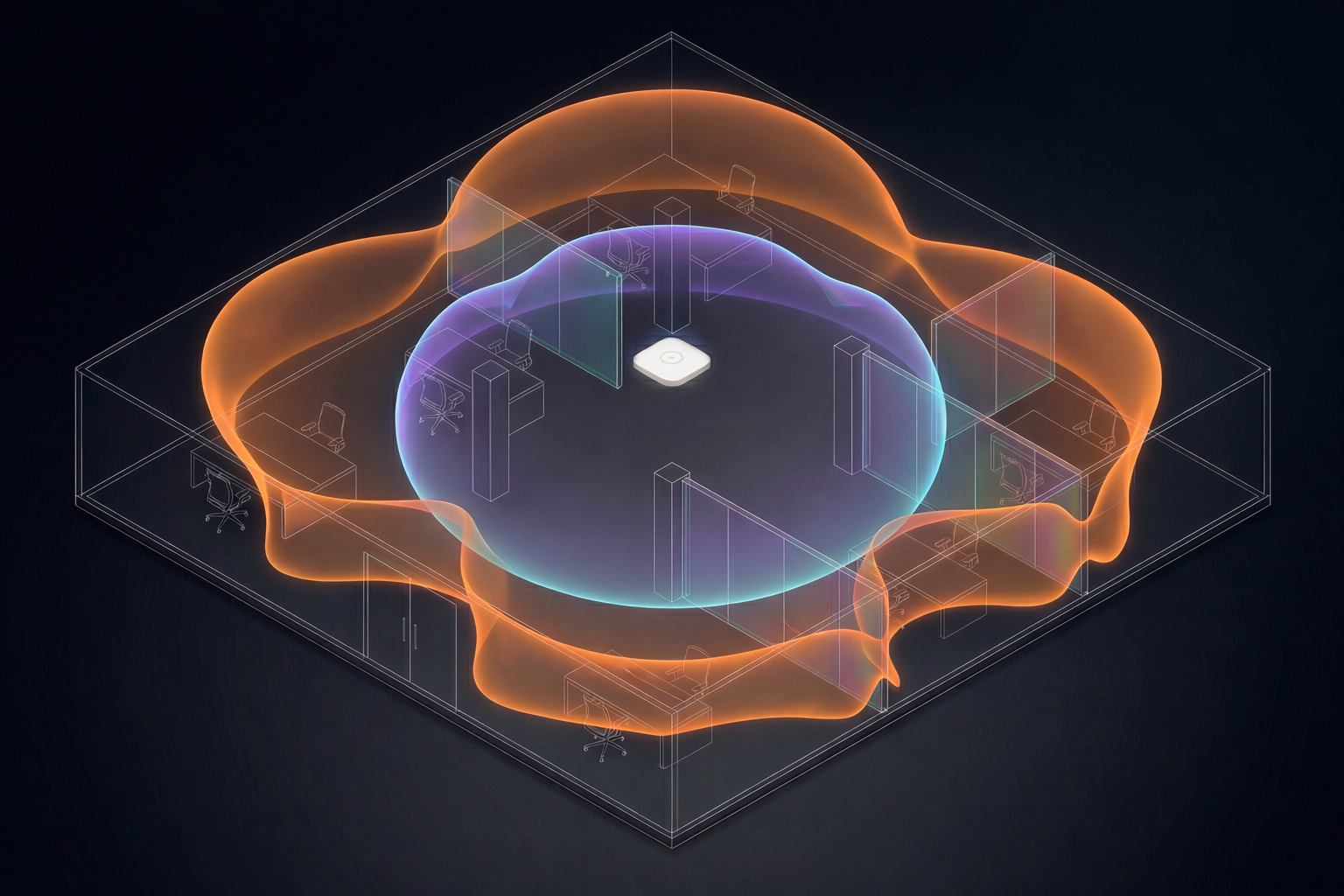
If you compare a 5 GHz access point running at full regulatory power to a 6 GHz access point running in Low Power Indoor mode, you may see a noticeable difference in coverage area. In that situation, the two radios may not be transmitting at the same power level. LPI limits how much energy the 6 GHz radio can put into the air, which naturally reduces how far the signal can travel before it falls below usable SNR. The smaller coverage footprint is primarily the result of lower permitted transmit power, not a fundamental change in how RF behaves at 6 GHz.
Standard Power with AFC
Standard Power 6 GHz devices can operate at higher transmit power, similar in scale to traditional 5 GHz enterprise deployments. However, they must coordinate through an AFC system to avoid interfering with incumbent users of the spectrum.
When 6 GHz runs at standard power levels, coverage behavior begins to look much more familiar.
When operating in Standard Power mode, 6 GHz access points can transmit at higher transmit levels, but only after coordinating through an Automated Frequency Coordination system. AFC evaluates the device’s location and assigns permitted channels and power levels to protect incumbent users of the band. That means available spectrum and transmit limits can vary by geography. In areas where AFC constraints limit power or channels, those regulatory limits directly shape effective cell size and design expectations.
Client Compatibility and Power Class Reality
Client support adds another layer to the Low Power vs Standard Power discussion.
Not all 6 GHz-capable devices are capable across both power classes. That means coverage expectations should account not only for AP transmit power, but also for client radio compatibility across the different power classes.
As with most 6 GHz planning decisions, inventorying actual client support tends to resolve ambiguity faster and inform your network design decisions.
Spectrum and Airtime: The Real Advantage of 6 GHz
A defining characteristic of 6 GHz is spectrum availability. In the U.S., there is up to 1200 MHz of spectrum. That enables:
- Twice the amount of channels available with 5 GHz
- Clean 80 MHz operation
- Extremely wide 320 MHz channels
This changes airtime behavior. More spectrum reduces the probability of co-channel interference. It provides flexibility in dense environments. It provides increased security because WPA3 is required in 6 GHz. Performance gains often show up because the medium is cleaner and less congested.
Channel Width and SNR Expectations
Wider channels increase peak throughput. They also increase SNR requirements. If you deploy 6 GHz using 160 MHz or 320 MHz channels, you will be able to achieve extremely high throughput but this is only feasible in environments with a handful of APs.
The increased spectrum available in 6 GHz makes clean 80 MHz channelization practical in enterprise environments. In the U.S., 5 GHz offers only six total 80 MHz channels, and just two of those avoid DFS. By contrast, 6 GHz provides fourteen non-overlapping 80 MHz channels, all free from legacy radar constraints, materially changing capacity planning and channel reuse in dense deployments.
Where Wi-Fi 7 Enters the Discussion
Wi-Fi 7 introduces:
- 4096-QAM
- Multi-Link Operation
- Multi-RUs
These PHY-level changes can operate in 5 GHz or 6 GHz. It’s important not to attribute Wi-Fi 7 performance characteristics solely to 6 GHz. The generation and the band are independent contributors.
Practical Design Considerations
When planning 5 GHz and 6 GHz together:
- Understand whether your 6 GHz deployment is LPI or Standard Power.
- Align channel width with your SNR and coverage expectations.
- Evaluate client support and distribution.
- Measure airtime utilization, client performance, and retry behavior rather than assuming theoretical maximums will translate into practice.
If you’re working through a 5 GHz and 6 GHz design right now, I would encourage you to watch the full webinar. We walk through live testing scenarios and examine where assumptions held up and where they didn’t. Seeing the measurements, client performance, and coverage comparisons in context tends to clarify the discussion far more quickly than theory alone.
Reading about Wi-Fi performance is one thing. Validating performance in your own environment is another. Wyebot measures Wi-Fi and wired performance from the client perspective across 2.4 GHz, 5 GHz, and 6 GHz, helping teams understand RF conditions, client behavior, and end-to-end network performance. If you want to see how your environment actually behaves, request a demo or trial sensor from our team.
5 GHz vs 6 GHz Q&A
What is the difference between 5 GHz Wi-Fi and 6 GHz Wi-Fi?
The primary difference between 5 GHz Wi-Fi and 6 GHz Wi-Fi is available spectrum and regulatory constraints. In the United States, 6 GHz provides up to 1200 MHz of additional spectrum, enabling more non-overlapping 20, 40, 80, and 160 MHz channels. RF propagation physics remain similar, although 6 GHz experiences slightly higher attenuation than 5 GHz under identical conditions.
What is Low Power Indoor (LPI) 6 GHz Wi-Fi?
Low Power Indoor (LPI) is a regulatory class for 6 GHz Wi-Fi access points and clients. LPI devices must operate indoors and are limited to lower transmit power levels. LPI does not require Automated Frequency Coordination (AFC). Because of lower permitted EIRP, 6 GHz LPI deployments may have smaller effective coverage areas compared to full-power 5 GHz deployments.
What is Standard Power 6 GHz with AFC?
Standard Power 6 GHz access points can transmit at higher power levels than LPI devices but must use Automated Frequency Coordination (AFC) to avoid interfering with incumbent spectrum users. When operating at comparable transmit power levels, Standard Power 6 GHz coverage can resemble traditional 5 GHz enterprise Wi-Fi deployments.
Does 6 GHz Wi-Fi have less range than 5 GHz Wi-Fi?
6 GHz Wi-Fi experiences slightly lower signal strength than 5 GHz Wi-Fi due to higher frequency. However, real-world range depends more on transmit power class (LPI vs Standard Power), antenna characteristics, channel width, and environmental attenuation. Frequency alone does not determine coverage.
What is Wi-Fi 6E?
Wi-Fi 6E is 802.11ax (Wi-Fi 6) operating in the 6 GHz band. It uses the same PHY and MAC features as Wi-Fi 6 in 5 GHz but expands operation into the newly available 6 GHz spectrum.
Is Wi-Fi 7 required to use 6 GHz?
No. Wi-Fi 6E already operates in the 6 GHz band. Wi-Fi 7 (802.11be) introduces additional PHY features such as 4096-QAM and Multi-Link Operation (MLO), and those features can operate in both 5 GHz and 6 GHz where supported.
If you want to go deeper into the technical details behind 6 GHz, Standard Power, AFC, and real-world testing, you may also want to review:
- Why 6 GHz Is Not the Upgrade Most Enterprises Expect [Video]
- U.S. Frequency Allocations Chart – NTIA
- FCC Report & Order on 6 GHz Unlicensed Spectrum (FCC-18-147)
- When the Same Doesn’t Mean Equal – Jim Palmer [Video]
- Understanding 6 GHz Unlicensed Spectrum – Cisco Whitepaper
- Unlocking 6 GHz Wi-Fi: AFC and Standard Power – Qualcomm Whitepaper
- MCS Index Reference Guide